
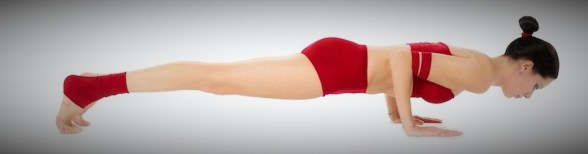
Chaturanga Dandasana, translates to Four-Limbed Staff Pose in English, and is often called Crocodile in many Western yoga classes. Chatur = four + anga = limb / Danda = staff + asana = pose.
Yoga is the union of body and mind, so a consistent yoga practice can be beneficial physically and mentally. Physically, Chaturanga helps to strengthen and tone the arms and forearms. It can also help develop flexibility in the wrists. And best of all, it tones the abdominal muscles: six-pack abs of steel–yes please! Mentally, Chaturanga deepens the awareness of body alignment through the arms and midline, and can sharpen your patience.
It is a foundational pose in the Sun Salutations sequence, a staple in most yoga warm-ups. Yogis will hear Chaturanga cued in just about every class, which means you can expect to do it…A LOT. When practicing any movement repeatedly, you must make sure you’re doing it correctly to prevent injury, in this case to the rotator cuffs. Engage those shoulders!
The problem is that Chaturanga is not easy, so many yogis, myself included, are guilty of messy alignment. It’s a challenging pose that requires significant, arm, shoulder, and core strength. If you happen to be weak in any one of those areas, it may seem impossible to gracefully move from High Plank to Chaturanga through to Up Dog and back to Down Dog like you have seen many a practiced yogi do seemingly effortless. There is no comparison in yoga, and you can get there too with a consistent yoga practice. On the plus side, each practice is another opportunity to get stronger, more flexible, and balanced like yin and yang. Yoga practice is a journey with no end goal or perfection in sight.
So what can you do on your journey to a well-executed Chaturanga? First of all, you can work on building your strength with prep poses. Next, you can modify the pose to fit your unique body versus forcing your body to fit some nonexistent ideal. Remember, in yoga the aim is to let go of ego and humbly enjoy where you are in your body in each moment. It’s more important for the pose to feel right than it is for it to look right.
However, just because you can, doesn’t mean you should. Practice satya, or truthfulness, be honest with yourself when considering what is safe for your body, and enjoy the journey. If you are taking care of injuries to the shoulders, wrists or back, avoid the full representation of this pose and practice using one of the modifications provided. Avoid Chaturanga altogether if you have carpal tunnel or a baby on board.
Getting into the Asana
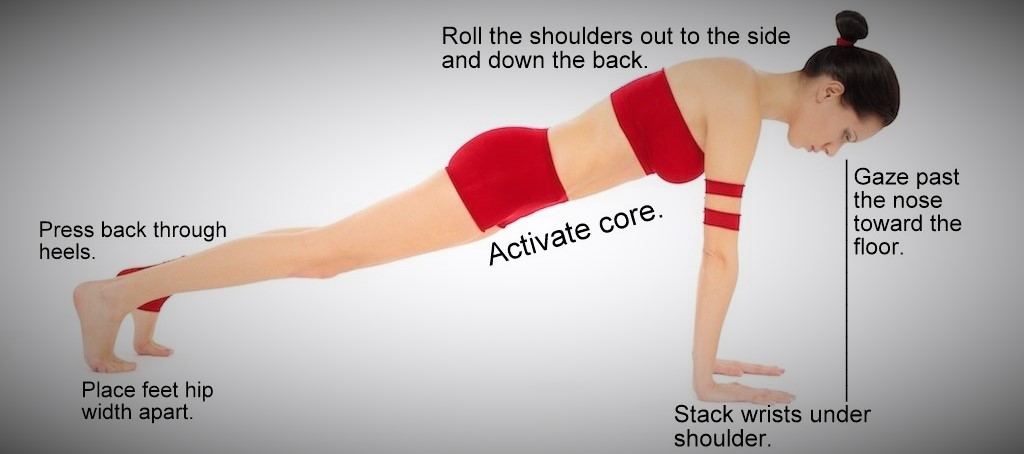
Warm up for Chaturanga with poses to help strengthen and the shoulders, arms and core like Plank Pose, Bhujangasana AKA Cobra, and Urdvha Mukha Svanasana AKA Upward-Facing Dog.
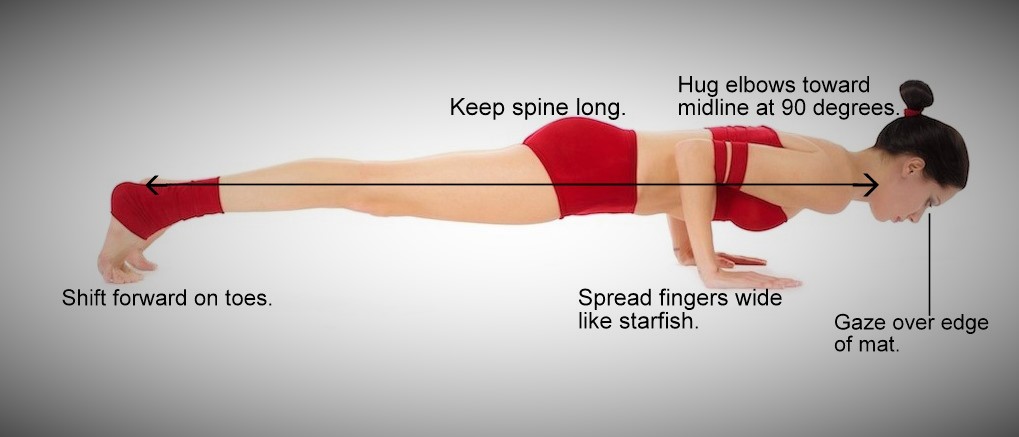
- Start in Downward-Facing Dog. Spread fingers wide like starfish, and press into the pads of the palm. Widen the space between the shoulder blades.
- Inhaling, shift forward on the balls of the feet into High Plank, bringing the shoulders directly above the wrists and elbows. Activate the legs, internally rotate the thighs, and gently pull them in toward one another. Activate the core adn draw the pubis toward the naval.
- Exhaling, bend the arms toward a 90° angle and lower toward the earth for Chaturanga. Hug the elbows toward the midline of the body. Keep the shoulders in line with the elbow without letting them dip any lower. Pull the shoulders back away from your ears, and shine chest forward. Do not lower or lift the chin, and keep the back of the neck long.
- Remember to breathe!
- To exit
- Gently lower all the way down to your belly.
- Lower the hips and slide the chest forward for Cobra or Up Dog.
- Hold for 10-30 seconds and press back to Down Dog.
Modifications & Props
- If you’re working on increasing strength in the shoulders, arms, or core, go ahead and lower your knees to floor for kneeling Chaturanga.
- If you have difficulty with kneeling Chaturanga or you want to get a feel for the correct muscle activation, practice standing with the palms on a wall and moving through the motions.
- If your shoulders dip lower than your elbows, wrap a d-ring yoga strap around your arms just above the elbow. The strap keeps you from lowering too close to the floor and help develop muscle memory.
- To deepen the pose, lay a rolled blanket or yoga mat on the floor below your Plank Pose parallel to your spine. Lower yourself toward the support and gently hover over it without lying all the way down.
- To increase strength, work towards holding the pose for 30, 45, then 60 seconds. Eventually, try adding some yoga pushups, or even attempt it from Three-Legged Dog with one foot of the ground.
Photo Credit
- “Chaturanga-Dandasana high Yoga-Asana Nina-Mel” by Kennguru is licensed under Creative Commons Attribution CC BY 3.0.
- “Chaturanga-Dandasana low Yoga-Asana Nina-Mel” by Kennguru is licensed under Creative Commons Attribution CC BY 3.0.
 My Fair Yogi

